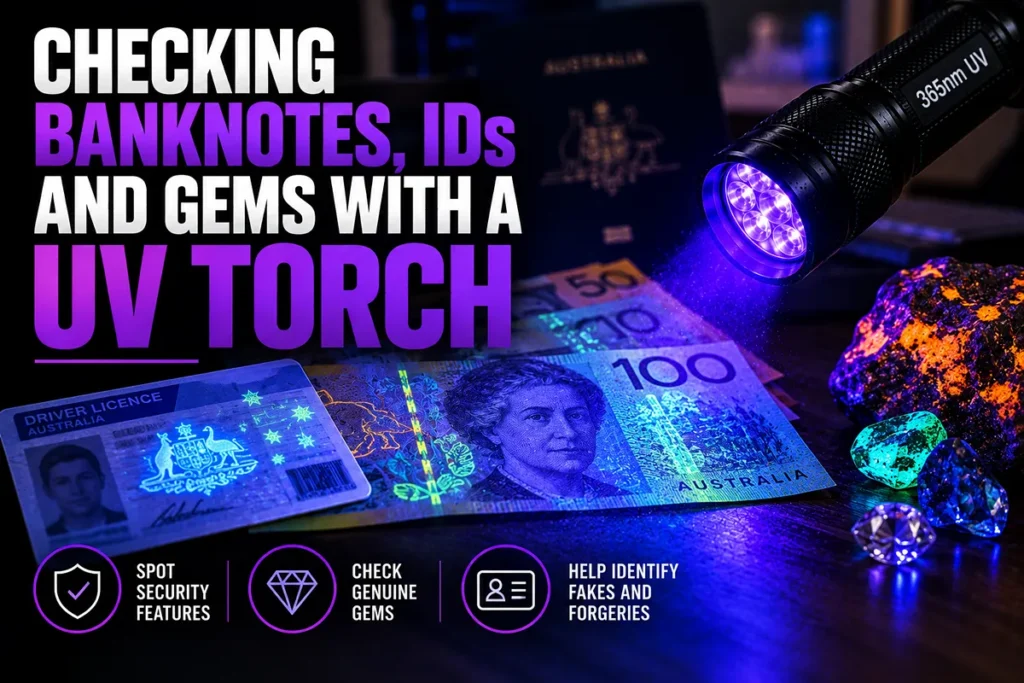
Checking Banknotes, IDs and Gems with a UV Torch
What UV reveals on documents and stones
Banknote security features
Australian polymer notes carry fluorescent elements, including a serial number and a patch that appear under UV but are invisible in ordinary light.
Identity documents
Licences, passports and many official cards include fluorescent inks, fibres or overlays that are difficult and expensive to reproduce convincingly.
Gem responses
Amber typically glows blue-white, chromium-bearing ruby glows red, and some treated or synthetic stones respond differently to their natural counterparts.
Paper and substrate
Most modern office paper contains optical brighteners and glows bright white. Genuine banknote and document substrates generally do not.
Not proof on its own
A convincing UV response is one signal among several. Good forgeries can replicate fluorescence, and genuine items can respond oddly after wear or washing.
Use it alongside other checks
Feel, print quality, watermarks, microprint and the tactile features matter as much as fluorescence. UV supports those checks rather than replacing them.
The single most useful rule: bright white glow usually means ordinary paper. Most office and copy paper is loaded with optical brighteners, so a "banknote" or document that lights up uniformly white under UV is an immediate red flag — genuine security substrates are designed not to do that.
Checking Australian banknotes
Work somewhere dark and hold the note flat. Under 365nm, look for the fluorescent elements the Reserve Bank builds in — these include a fluorescent serial number and a patch that appears under UV, with the rest of the polymer substrate staying comparatively dark.
What should concern you is the opposite: a note that glows brightly and evenly across its whole surface. That points to ordinary paper stock rather than the polymer substrate Australian notes use. Feel and the clear window remain your first checks — UV is the confirmation step, not the starting point.
Documents and cards
Licences, passports and many membership or access cards carry fluorescent print, fibres or patterned overlays. The useful signal is whether the fluorescent design is crisp and correctly positioned. Reproductions often show fluorescence that is blurry, in the wrong colour, or slightly misaligned against the printed design.
If you are checking documents in a professional capacity, work from the issuer’s own published security guidance rather than memory — features change between issues and a genuine older document may legitimately differ from a current one.
Gems and jewellery
UV is a helpful screening tool for stones. Amber commonly fluoresces blue-white, while many plastic imitations do not respond the same way. Chromium-bearing ruby glows red, which can help separate it from red spinel or glass. Some synthetic and treated stones fluoresce differently from their natural equivalents.
Treat all of that as indicative only. Fluorescence varies between specimens of the same material, and no UV response confirms identity or value. For anything of consequence, a qualified gemmologist with proper equipment is the answer. If you are more interested in minerals in the field, our fossicking guide covers that in detail.
Getting a reliable result
- Use 365nm, filtered. A 395nm unit floods the item with visible violet and hides subtle features.
- Work in the dark and let your eyes adjust.
- Compare against a known-genuine item where possible — the contrast is far more informative than a single sample.
- Do not rely on UV alone. Combine it with feel, print quality and the tactile security features.
UV torches suited to verification work
Filtered 365nm units, which is what you need to see subtle security features rather than a violet wash.
Convoy S2+ UV 365nm (Nichia, Filtered)
Compact enough to keep at a counter or in a bag, and filtered so security features show cleanly. The sensible choice for retail, market stalls or anyone who wants an occasional check without spending much.
Tank007 UV-L03C 365nm Black Light
A dedicated 365nm black light with more output for frequent checking, whether that is documents, notes or stones. A solid step up if verification is part of your routine rather than an occasional need.
Convoy S12 UV 365nm Filtered (21700)
More runtime on a 21700 cell, which suits extended sessions such as sorting through a collection or working through a batch of documents without watching the battery.
UV safety: never look into the beam or at its reflection off a glossy note or card, wear UV-blocking eyewear with high-power units, and keep UV torches away from children. Reflected UV off a shiny surface is easy to overlook.
Frequently asked questions
Do Australian banknotes glow under UV light?
Yes. Australian polymer notes carry fluorescent security elements, including a fluorescent serial number and patch, while the rest of the substrate stays comparatively dark. A note that glows brightly and evenly all over is a warning sign.
Can a UV torch prove a banknote is genuine?
No. UV is one check among several and good forgeries can imitate fluorescence. Use it alongside feel, the clear window, print quality and the raised tactile features rather than on its own.
What UV wavelength is best for checking documents?
365nm with a filter. Cheaper 395nm torches emit heavy visible violet that obscures the subtle fluorescent detail you are trying to inspect.
Can UV identify gemstones?
It helps screen them. Amber often glows blue-white and chromium-bearing ruby glows red, which can separate them from imitations. Response varies between specimens, so UV indicates rather than confirms — use a qualified gemmologist for anything valuable.
Where can I buy a UV torch for checking notes in Australia?
MaxBeam Australia stocks genuine 365nm UV torches from Convoy, Tank007, Weltool and more, shipped Australia-wide with full Australian warranty and local support — not grey-market import.
See the Features Daylight Hides
Free shipping on orders over $99 — Australian warranty on every torch — Expert advice available
Shop UV Torches💬 Not sure which one? Message us on WhatsApp