Can Your Phone Work as a UV Light? What Actually Happens
Why a phone cannot produce UV light
Screens emit visible light only
Phone displays are built from red, green and blue subpixels. The shortest wavelength they emit is blue at roughly 450nm — nowhere near the 365nm needed to excite most fluorescence.
The flash is a white LED
A camera flash is a standard white LED, designed to light a scene for a photo. It emits across the visible spectrum and produces no meaningful ultraviolet output.
Apps only change colour
A "UV light" app simply fills your screen with purple or blue. It looks like a black light, but it is visible light with a violet tint — no fluorescence is being excited.
Purple is not ultraviolet
Ultraviolet is beyond the range human eyes can see. If you can see the light itself clearly, most of what you are looking at is visible violet, not UV.
Glass blocks UV anyway
Even if a phone could emit UV, the glass covering the screen and camera absorbs a large share of shorter wavelengths, which is one reason the approach was never viable.
What actually works
A dedicated 365nm UV LED with a filter. That combination excites fluorescence in minerals, pet stains and security features that a phone simply cannot reach.
The confusion is understandable: a purple screen looks like a black light. But fluorescence is caused by invisible ultraviolet being absorbed and re-emitted as visible light. If the light source is visible violet, there is nothing invisible to do the exciting — which is why nothing glows.
What about "UV" phone cases and clip-on lights?
Clip-on lights that attach to a phone are a different matter — some do contain a genuine UV LED. The question is which wavelength. Most inexpensive clip-ons use 395nm, which emits a lot of visible violet and produces weak, washed-out fluorescence. A few use 365nm, which is the wavelength that actually works. If a listing does not state the wavelength, assume 395nm.
The other limitation is power. A clip-on running off a phone battery is a fraction of the output of even a modest dedicated torch, so it struggles with anything but the strongest fluorescence in complete darkness.
What you can actually see with a real UV torch
Once you move to a genuine 365nm torch, a lot becomes visible that was not before:
- Pet stains — dried urine fluoresces, which is why UV is the standard way to find it. Our guide to finding cat urine covers the technique.
- Fluorescent minerals — hyalite opal, fluorite and calcite glow under longwave UV. See our fossicking guide.
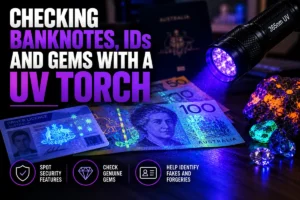
- Security features — Australian banknotes and many identity documents carry deliberately fluorescent elements.
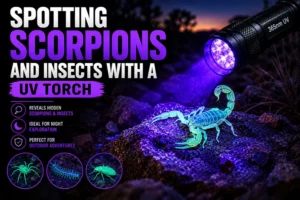
- Scorpions — they fluoresce a distinctive blue-green, which makes UV a genuinely useful camping tool.
How to choose if you are buying your first UV torch
Two specifications matter more than anything else. First, 365nm rather than 395nm — the shorter wavelength excites far more fluorescence and is mostly invisible. Second, a filter (Wood’s glass), which blocks the residual visible light the LED still emits so your eyes see the glow instead of the torch.
Beyond that, match output to the job. Close-range work at home needs very little power; scanning a campsite or rock face needs more.
UV torches that actually work
All genuine 365nm units held in stock, from an affordable first torch up to a do-it-all white-plus-UV light.
Convoy S2+ UV 365nm (Nichia, Filtered)
The one we start most people on. A true 365nm Nichia LED paired with a black filter glass that blocks residual visible light, so faint fluorescence shows up cleanly. Compact, well built and the natural replacement for anyone who has been trying phone apps.
Tank007 UV-L03C 365nm Black Light
A dedicated 365nm black light that handles everything from pet stains to security checks. A step up in output from the S2+, and the model that already does much of the heavy lifting for UV searches on our site.
Fenix WF25RM (3000lm White + UV)
One torch for general use with UV available when you need it. A rugged 3000-lumen white duty light plus a UV mode for quick fluorescence checks. The UV here is a secondary function rather than a filtered specialist output, so it suits versatility over ultimate UV performance.
Worth knowing before you buy: UV safety still applies. Longwave 365nm is safer than shortwave, but do not look into the beam or shine it at anyone’s eyes, and keep UV torches away from children.
Frequently asked questions
Can my phone be used as a UV light?
No. Phone screens emit visible red, green and blue light, and the camera flash is a white LED. Neither produces ultraviolet, so no app can make your phone excite fluorescence.
Do UV light apps actually work?
They only fill the screen with purple or blue light. It resembles a black light but is ordinary visible light, so nothing fluoresces. There is no software fix for hardware that cannot emit UV.
Are clip-on phone UV lights any good?
Some contain a genuine UV LED, but most are 395nm and low power, which gives weak, washed-out results. A dedicated 365nm torch is far more effective and not much more expensive.
What wavelength UV torch should I buy?
365nm, ideally with a Wood’s glass filter. It excites the widest range of fluorescence and, when filtered, shows clean glows without a visible violet wash.
Where can I buy a real UV torch in Australia?
MaxBeam Australia stocks genuine 365nm UV torches from Convoy, Tank007, Weltool, Mateminco and Fenix, shipped Australia-wide with full Australian warranty and local support — not grey-market import.
Get a UV Torch That Actually Glows
Free shipping on orders over $99 — Australian warranty on every torch — Expert advice available
Shop UV Torches💬 Not sure which one? Message us on WhatsApp