Bioluminescence vs Fluorescence: What a UV Torch Can and Can’t Show You
The difference in one minute
Fluorescence needs a UV source
The material absorbs ultraviolet light and instantly re-emits it as visible light. Switch the torch off and the glow stops dead. This is what a 365nm UV torch is built for.
Bioluminescence makes its own light
A living organism produces light through a chemical reaction inside its own body. It needs no light source at all — and no torch can trigger it.
What triggers sea sparkle
Movement, not light. Noctiluca scintillans flashes when the water is disturbed by a wave, a paddle or a footstep. Shining UV at it does nothing.
Bright light works against you
Any bright torch destroys your dark adaptation, and bioluminescence is faint. The more light you shine, the less you will see.
Red light is the answer
For bioluminescence you want a dim red mode — enough to walk safely and find your gear, without wrecking the night vision you need.
UV is the answer for minerals
For fluorescent minerals, scorpions and pet stains, a filtered 365nm torch is exactly the right tool and there is no substitute.
The simple test: does it still glow when everything is switched off? If yes, it is bioluminescence and no torch will improve it — use red light and let your eyes adjust. If it only glows while a UV torch is pointed at it, that is fluorescence, and the wavelength and filter of your torch decide how well you see it.
What is bioluminescence, and where do you see it in Australia?
Bioluminescence is light produced by a chemical reaction inside a living organism. In Australia the two most sought-after examples are:
- Sea sparkle (Noctiluca scintillans) — a marine plankton bloom that flashes blue when the water is agitated. Reported from time to time around Tasmania, Gippsland, Jervis Bay and other southern coastal spots, usually in warmer months, but blooms are unpredictable and cannot be scheduled.
- Ghost fungus (Omphalotus nidiformis) — a native fungus that glows a soft green from the gills, typically on decaying wood in southern Australia after autumn and winter rain. It glows on its own, continuously, with no light source needed.
Neither responds to ultraviolet. If you point a UV torch at either one, nothing changes except that your eyes lose their dark adaptation.
A safety note on ghost fungus: it is toxic if eaten and has been mistaken for edible species. Look, photograph, don’t forage.
How to actually see bioluminescence
Go properly dark and wait
Get away from streetlights and car headlights, and give your eyes at least 20 minutes to dark-adapt. This single step does more than any piece of equipment. One glance at a phone screen undoes it.
Use red light only
Red light preserves dark adaptation far better than white. Use the lowest red setting that lets you move safely, and keep it pointed at the ground rather than at the water or your companions.
Create the disturbance
For sea sparkle, the light comes from movement — run a hand or a paddle through the water, or watch where waves break. For ghost fungus, simply look: it is already glowing, and your eyes just need time to pick it up.
Check conditions first
Blooms are reported through local community pages and citizen-science groups rather than any official forecast. Check recent local sightings before driving out, and mind your footing on dark, wet rocks and beaches.
What a UV torch is brilliant for
None of the above makes a UV torch useless — it is simply a different job. Under a filtered 365nm torch you can find:
- Fluorescent minerals — hyalite opal glowing vivid green, plus fluorite, calcite and others. Our fossicking guide covers this in full.
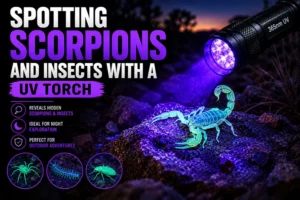
- Scorpions — they fluoresce a bright blue-green, which makes UV a genuinely useful camping tool.
- Some fungi and lichens — a number fluoresce under UV even though they are not bioluminescent, which is the source of much of the confusion.
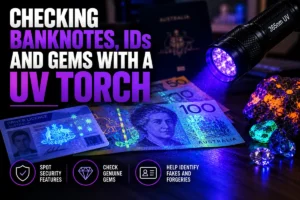
- Pet stains, security features and leaks — the everyday uses that make a UV torch worth owning.
So a fair summary: UV reveals fluorescence; patience and red light reveal bioluminescence. Plenty of people who go out looking for one end up enjoying the other.
The right torch for each job
Red-mode lights for bioluminescence nights, and a filtered 365nm torch for fluorescence. All held in stock.
Fenix SW05R-RED Pocket Cap Light
A dedicated red pocket light, which is exactly what you want on a dark beach. Clips to a cap or pocket, gives just enough light to walk and handle gear, and leaves your night vision intact. Small and cheap enough to keep in the car for whenever a bloom is reported.
Fenix HM55R Headlamp
A red mode for preserving night vision plus 1200 lumens of white when you need to find the track back to the car. Hands-free is genuinely useful on wet rocks and sand, and the dual output means one headlamp covers both the careful approach and the walk out.
Speras TH6 4-in-1 Zoomable
White, red and green in one zoomable torch. Worth it if you are out at night regularly for more than one reason — the red preserves night vision, the green suits wildlife spotting, and the white handles everything else. The most versatile night torch on this list.
Convoy S2+ UV 365nm (Nichia, Filtered)
If minerals are the real interest, this is the torch. A true 365nm Nichia LED behind a Wood’s glass filter, so faint fluorescence shows cleanly instead of being washed out by visible violet. The right tool for fossicking, scorpion spotting and checking finds — just not for bioluminescence.
Not sure which side of this your trip falls on? Message us on WhatsApp — tell us what you are hoping to see and we will tell you honestly whether you need UV, red light, or just a dark sky and some patience.
Frequently asked questions
Will a UV torch make bioluminescence glow?
No. Bioluminescence is light the organism generates chemically, so it needs no external light source and cannot be triggered by ultraviolet. Shining a UV torch at sea sparkle or ghost fungus does nothing except reduce your night vision.
What is the difference between bioluminescence and fluorescence?
Fluorescence is a material absorbing UV and re-emitting it as visible light — it stops the moment the UV source is switched off. Bioluminescence is light produced by a chemical reaction inside a living organism, and continues with no light source at all.
What torch should I take to see sea sparkle?
A red-mode torch on its lowest useful setting, such as the Fenix SW05R-RED or a headlamp with a red mode. Red light preserves the dark adaptation you need, while white or UV light works against you.
Where can I see bioluminescence in Australia?
Sea sparkle blooms are reported periodically along southern coastlines including Tasmania, Gippsland and Jervis Bay, while ghost fungus appears on decaying wood in southern Australia after autumn rain. Both are unpredictable — check recent local sightings rather than planning around a fixed season.
Do any fungi glow under a UV torch?
Some fungi and lichens do fluoresce under 365nm UV, which is separate from true bioluminescence. Ghost fungus glows on its own without any UV. This overlap is why the two phenomena are so often confused.
Where can I buy UV and red light torches in Australia?
MaxBeam Australia stocks genuine 365nm UV torches and red-mode lights from Fenix, Convoy, Speras, Nitecore and more, shipped Australia-wide with full Australian warranty and local support — not grey-market import.
The Right Light for a Dark Night
Free shipping on orders over $99 — Australian warranty on every torch — Expert advice available
Shop Torches💬 Not sure which one? Message us on WhatsApp