Best Torches for Search and Rescue Volunteers in Australia (2026 Guide)
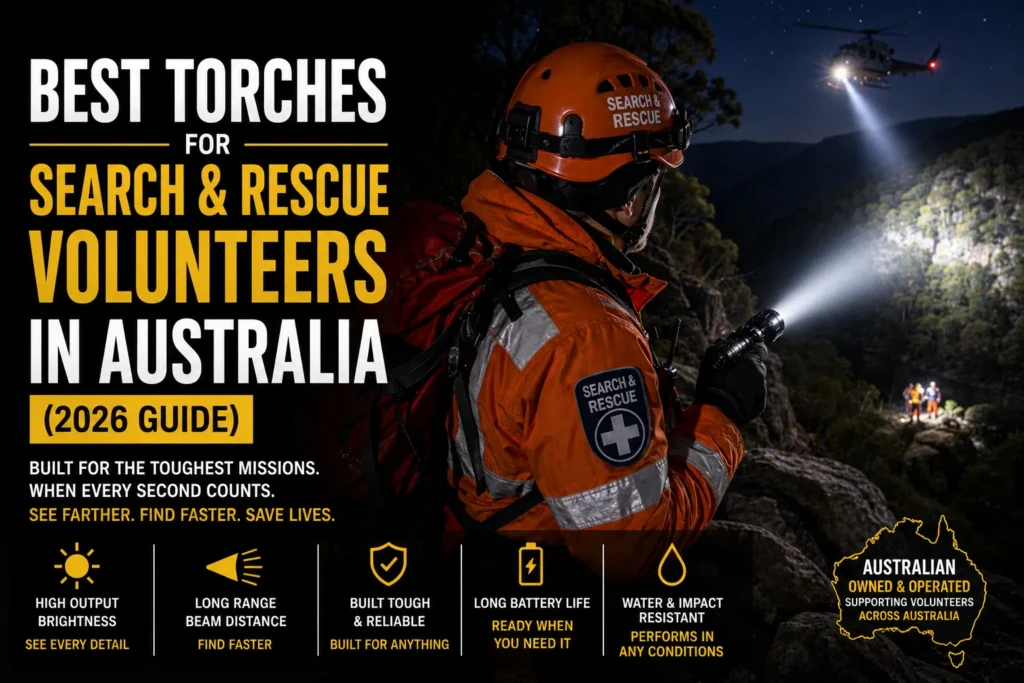
For search and rescue volunteers - SES, bush search teams, marine rescue, and emergency response - a torch is not just a piece of kit. It's a lifeline, a search tool, a signal, and sometimes a navigation aid all in one. The right torch helps you find a missing person at 2am in dense bush, light up a casualty for assessment, signal a helicopter, or simply find your way out of unfamiliar terrain. Here's our 2026 guide to the best torches for Australian SAR volunteers.
Why SAR Demands More Than a Regular Torch
Search and rescue operations push lighting equipment to its limits. Operations can run all night in cold, wet, dense bush or rugged terrain. Subjects need to be located across hundreds of metres of scrub or open country. Casualties need to be assessed and evacuated. Volunteers need to navigate, communicate, and stay safe themselves.
A consumer-grade torch fails at the first serious test - either it runs out of battery, can't throw far enough to be useful for searching, or doesn't survive the environment. SAR-grade torches are different. They combine extreme throw distance for searching, sustained runtime for long operations, reliable build quality for harsh conditions, and strobe/SOS modes for signalling. They're the kind of tool that earns its place in your operational kit because it has to work, every single time.
What to Look for in a SAR Torch
Long Beam Throw
500m+ throw is the minimum for serious search work. Higher-end options reach 2km+ - critical for spotting subjects across valleys, ridgelines, or open terrain.
High Lumen Output
2,000+ lumens for area searches and scene illumination. Higher output also helps subjects see you, not just the other way around.
Strobe & SOS Modes
Signalling capability matters - both for being seen by aircraft and ground teams, and for marking your own location during night operations.
Extended Runtime
SAR operations can run 8-12+ hours. USB-C rechargeable with high-capacity batteries lets you top up from a vehicle USB or powerbank between tasks.
Hands-Free Headlamp
Casualty assessment, rope work, map reading, GPS use - all need both hands. A quality headlamp paired with a handheld is the standard SAR setup.
Tough & Waterproof
Aircraft-grade aluminium, IPX7+ waterproofing, and 1m+ impact resistance. SAR torches need to survive drops in mud, rain, and creek crossings.
Throw distance matters more than total lumens for SAR. A 2,000-lumen torch with 1,400m throw will find a subject faster than a 5,000-lumen torch with 300m throw. When you're searching open country, ridgelines, or large bush areas, beam reach is what actually finds people. Read more on lumens vs throw when choosing.
Our Top Torch Picks for Search and Rescue Volunteers
All in stock at MaxBeam Australia with full Australian warranty support. Selected specifically for the demands of SAR work. We've grouped our picks into handheld search torches, head torches, and specialist long-throw options so you can build the right kit for your role.
Handheld Search Torches
Acebeam W35 Tactical
The W35 is one of the most capable search torches we stock. 8,000 lumens of pure output combined with a 2,600-metre beam throw - meaning you can scan across valleys, ridgelines, and large open spaces in a single sweep. Tactical-grade build quality means it survives genuine SAR conditions: rain, cold, drops, and 8+ hour operations. The combination of high output AND extreme throw makes it our top pick for primary SAR handheld use.
Nitecore MH12 Pro
A serious workhorse torch for SAR volunteers. 3,300 lumens with a 505-metre beam throw makes it versatile for both general search work and scene illumination. USB-C rechargeable, full waterproof rating, and built tough enough for multi-day operations. The MH12 Pro is the torch we recommend most often for SAR teams wanting genuine professional capability without going to the very top of the price range.
Klarus XT21X Pro
If you want maximum output combined with tactical features, the XT21X Pro delivers. 4,400 lumens with a 336-metre beam, dual tail switch design for instant momentary-on, and a dedicated strobe button for signalling. IPX8 waterproofing handles any weather. The dual switch is especially useful for SAR - momentary illumination for quick checks, constant-on when you need to commit to a sustained search pattern.
Head Torches
Nitecore HC65 UHE
A SAR-grade headlamp that delivers serious performance for hands-free work. 2,000 lumens with a 222-metre beam throw - more than enough for navigation, casualty assessment, rope work, map reading, and GPS use. Flood and spot beams combined mean you can see what's in front of you AND scan ahead at the same time. Rechargeable and rugged enough for the conditions SAR volunteers actually face.
Specialist Long-Throw
Acebeam W50 2.0
For specialist roles needing extreme distance identification - subjects across large valleys, ridgeline searches, or maritime use - the W50 2.0 is in a category of its own. 1,900 lumens of focused output reaching an extraordinary 5,062 metres (over 5km) of beam throw. Lower total lumens than the W35, but the beam is tightly focused for genuine extreme-range work where reach matters more than wide-area illumination.
Acebeam W20 LEP Tactical
An LEP (Laser Excited Phosphor) torch produces an extremely tight, long-throw beam with almost no light spill - meaning the beam reaches far without lighting up everything around you. 600 lumens but a 1,100-metre throw, useful for precise long-range identification or surveillance work where you want to see without being seen. A specialist tool that earns its place for specific SAR scenarios.
Quick Comparison
| Torch | Type | Lumens | Throw | Best For |
|---|---|---|---|---|
| Acebeam W35 | Handheld | 8,000 | 2,600m | Primary SAR torch |
| Nitecore MH12 Pro | Handheld | 3,300 | 505m | All-conditions search |
| Klarus XT21X Pro | Handheld | 4,400 | 336m | Tactical SAR / signalling |
| Nitecore HC65 UHE | Headlamp | 2,000 | 222m | Hands-free SAR work |
| Acebeam W50 2.0 | Handheld | 1,900 | 5,062m | Extreme-range spotting |
| Acebeam W20 LEP | Handheld | 600 | 1,100m | Precision identification |
Buying Tips for SAR Volunteers
Build a layered kit - don't rely on one torch
The most effective SAR volunteers carry layered lighting: a high-throw primary handheld for searching, a headlamp for hands-free work, and ideally a compact backup torch in case of failure. Each tool covers scenarios the others can't. Many experienced SAR volunteers also carry a specialist long-throw or LEP torch for specific terrain types.
Throw distance matters more than raw lumens
For search work specifically, beam throw is the metric that matters. A 2,000-lumen torch with 1,400m throw will find a subject across open ground faster than a 5,000-lumen torch with 300m throw. When you're scanning large areas, reach beats brightness every time.
Carry spare power
Long SAR operations drain torches faster than you'd expect, especially on turbo modes. A USB-C powerbank in your pack means you can keep your primary torch running even on a 12-hour callout. Several of our top picks (MH12 Pro, XT21X Pro, W20) charge directly from USB-C.
Need help building a SAR kit? Message us on WhatsApp or call +61 452 508 808 - we work with SES units, marine rescue, and bush search volunteers regularly and can recommend the right combination for your team's work.
Frequently Asked Questions
How many lumens do I need for SAR work?
For most SAR work, 2,000-4,500 lumens is plenty. The key metric is actually beam throw distance, not total lumens - a torch with 500m+ throw will outperform a higher-lumen torch with shorter throw when searching open terrain. For specialist long-range work, consider an LEP torch like the Acebeam W20.
Are these torches waterproof enough for SAR work?
Yes - all the torches in this guide are rated IPX7 or better, meaning they survive rain, splashes, and brief immersion. The Klarus XT21X Pro is IPX8 for sustained submersion. For more on what these ratings mean, see our IPX7 guide and IPX8 guide.
What's the difference between LED and LEP torches?
LED torches produce more total light spread over a wider beam, while LEP (Laser Excited Phosphor) torches produce a much tighter, focused beam that reaches significantly further. For SAR, LED is better for general search and scene illumination, while LEP excels at long-range identification and precision work. Many serious SAR volunteers carry both.
How long should a SAR torch run on a single charge?
Most SAR-grade torches will run 3-8+ hours on practical brightness levels (around 1,000-2,000 lumens), and significantly less on turbo. For 8-12+ hour operations, carry a USB-C powerbank to recharge in the field. The trade-off is that maximum lumen modes generate heat and drain batteries fast - they're typically time-limited by design.
Can these torches handle Australian bush conditions?
Yes - all torches in this guide use aircraft-grade aluminium bodies, are rated for impact resistance, and are built for sustained outdoor operational use. They're significantly more durable than consumer torches and have been used by SAR teams in conditions ranging from coastal rescue to alpine search work.
Are MaxBeam torches covered by Australian warranty?
Yes - every torch sold by MaxBeam Australia comes with full Australian warranty support. You deal with us directly, not an overseas distributor. Most brands we carry offer 2-5 year warranties. Contact us if you ever have an issue.
Build Your SAR Kit
Free shipping on orders over $99 - Australian warranty on every torch - Expert advice available
Shop SAR Torches💬 Prefer to chat? Message us on WhatsApp